
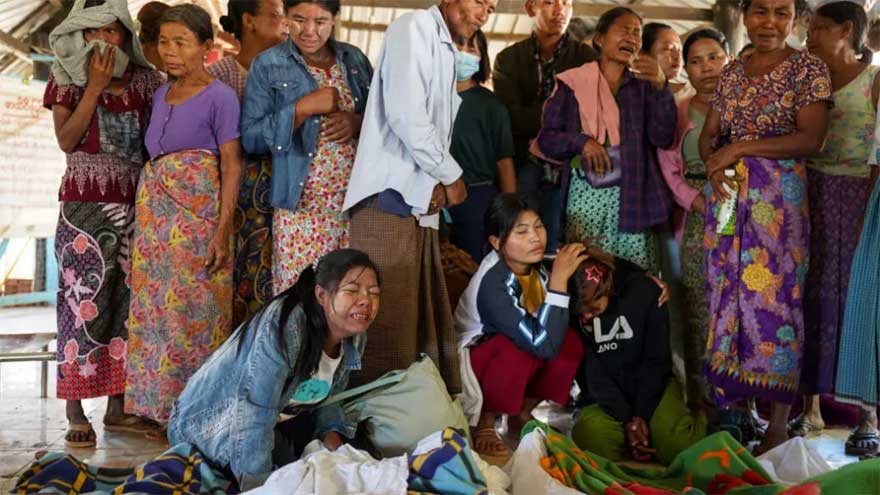
YANGON (AFP) – More than 100,000 people have been killed across all sides in Myanmar since a military coup five years ago triggered civil war, a conflict monitor said.
_x000D_
The military ousted the elected government of Aung San Suu Kyi in February 2021, detaining the Nobel Peace Prize laureate and ending Myanmar’s decade-long experiment with democracy.
_x000D_
Anti-putsch protests were put down by security forces but activists quit cities to form pro-democracy guerrilla groups, fighting alongside ethnic minority armies that have long resisted central rule.
_x000D_
There have been 100,114 conflict-related fatalities since the coup, according to the latest data from monitoring group Armed Conflict Location & Event Data (ACLED), which tallies media reports of violence.
_x000D_
There is no official toll and estimates vary widely, but analysts regard the half-decade civil war as Asia’s deadliest active conflict.
_x000D_
“The pain is just endless,” said 49-year-old Thein Aye Nu, whose husband was killed in an airstrike in the western state of Rakhine last month.
_x000D_
“I am so deeply resentful and very angry. But I don’t even know who to be angry at anymore. I just have to console myself by accepting it as fate.”
_x000D_
‘So many memories’
_x000D_
Myanmar was ruled by diktat by military chief Min Aung Hlaing for five years after the coup.
_x000D_
He retired from the armed forces to take office as civilian president in April after deeply restricted elections blocked by rebels from their territory, and in which Suu Kyi’s party was sidelined.
_x000D_
Democracy monitors dismissed the vote as a charade to rebrand Min Aung Hlaing’s rule, and rebels rejected his call for fresh peace talks as an insincere ploy to launder his image abroad.
_x000D_
“If there was no coup, children would be studying at schools,” said one man in Myit Chay town in central Magway region whose teenage son was killed recently.
_x000D_
He said his son died in combat after running away from home to fight for pro-democracy rebels.
_x000D_
“We didn’t even get a chance to properly chant Buddhist funeral rites. Heavy artillery was being fired,” he said.
_x000D_
“He left so many memories – I am not satisfied to have done so little for him.”
_x000D_
Whole-country conflict
_x000D_
More than 3.7 million people are internally displaced in Myanmar, according to the United Nations, and more than one in five face acute food insecurity as the country slides back into poverty.
_x000D_
In the largest city, Yangon, violence can take the form of occasional assassinations.
_x000D_
Other places are riven by entrenched warfare or pounded by daily airstrikes by the military’s Russian- and Chinese-supplied jets.
_x000D_
Myanmar was the second-most conflict-hit area in the world last year, according to ACLED, behind only the Palestinian territories.
_x000D_
ACLED has registered more than 1,200 distinct armed groups in the civil war, calling it “the most fragmented conflict in the world”.
_x000D_
“It’s deadly, it’s dangerous to civilians, the conflict has spread across the whole country,” said ACLED senior analyst Su Mon.
_x000D_
The conflict dynamic has shifted at times in favour of both sides.
_x000D_
A combined offensive among some rebels starting late 2023 saw them win stunning advances, bearing down on the second largest city Mandalay — with speculation they may even capture the ancient royal capital.
_x000D_
But the tide has turned back in favour of the military, analysts say, after China threw support behind it and Beijing-backed truces were signed with two of the most powerful ethnic minority armies.
_x000D_
‘Sent to die’
_x000D_
In February 2024, the military activated conscription legislation, aiming to bolster its ranks by forcibly recruiting 50,000 citizens.
_x000D_
“These conscripts can’t do anything. It’s like they are just being sent to die,” said one former military conscript who deserted after serving on the front lines.
_x000D_
“If you don’t die in one place, they send you to another,” the 20-year-old said on condition of anonymity for security reasons.
_x000D_
The war has also had far-reaching consequences abroad, filling camps in neighbouring Thailand and Bangladesh with an exodus of refugees, and creating fertile ground for transnational criminal enterprise.
_x000D_
Armed groups on all sides fill their war chests with profits from the booming production of drugs such as heroin and methamphetamine, monitors say.
_x000D_
Meanwhile Myanmar’s loosely governed borderlands have become a hotbed for online scam centres often operating out of fortified compounds guarded by militants.