

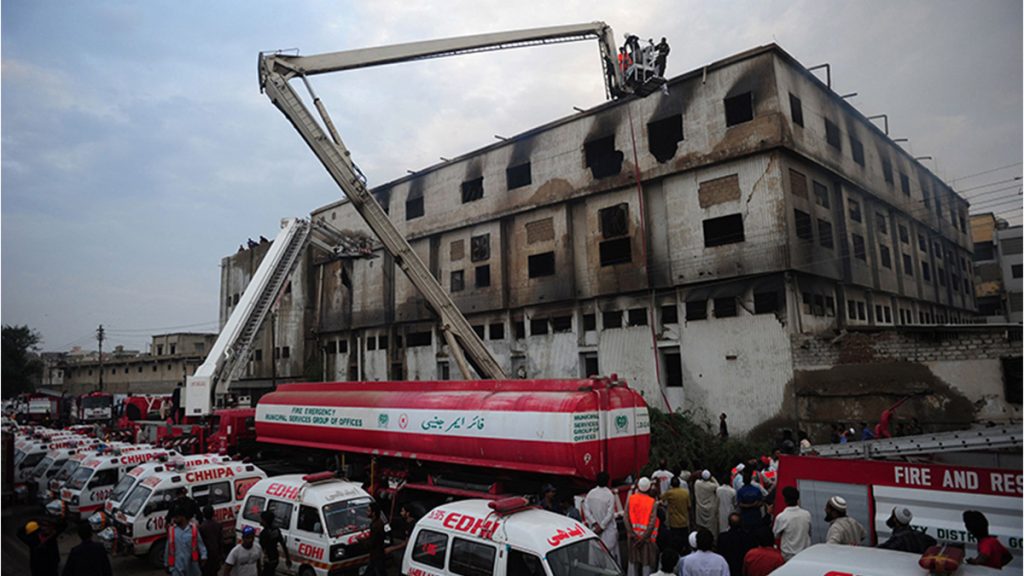
The case of burning down the Ali Enterpriser factory in Baldia Town, which was pending in the courts for fourteen years, has finally been decided in the acquittal of the accused. From the beginning to the final decision of the Supreme Court Registry Karachi, several twists and turns emerged in this case. The named accused Abdul Rehman alias Bhola and Zubair Charia were acquitted from the case. The Supreme Court also issued a summary judgment acquitting both the accused. On September 11, 2012, a fire broke out in the Ali Enterpriser garment factory located in Baldia Town, Karachi. Initially, the fire incident was declared a short circuit and an accidental accident, but later the case took many turns and heartbreaking details emerged. Since more than two hundred and sixty people are burnt alive in this fire incident, there is a riot, cries for justice are raised and loud claims are made to provide justice. The biggest reason for the death of so many workers due to burning was the closure of the factory doors and the closure of all emergency exits.
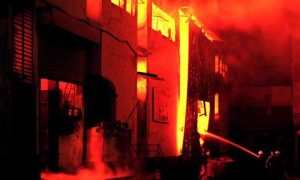
The question is, were the doors closed? Why were the doors not opened despite the fire? Was there an attempt to save anyone alive after the fire? Who were the ones who did not allow the doors to be opened? Who were the ones who closed all the exits from the factory and guarded them so that no one could open them? The question is also why would the factory owners do this? Why would they take the lives of their own workers? Initially, the police registered a case of negligence and carelessness against the factory owners, at that time it was declared as poor safety arrangements and an industrial accident. In February 2015, a JIT report was submitted by the Sindh Rangers to the Sindh High Court, which completely changed the course of the case. The factory’s accountant also appeared before this JIT and gave a statement about how the fire started. In his statement to the JIT, the factory’s accountant told that at around 8:30 pm that night, he was asked to bring a file from the office, which was located near the warehouse. Upon reaching there, he felt a strange smell. When he came out of the office, he saw fire starting and flames rising in the blink of an eye. He said that it was not possible to stand in that place due to the heat. He ran away from there screaming. At the same time, the order was given to turn off the main switch to avoid a short circuit.
According to the production manager, when the accountant came out of the office after he screamed, the fire had spread. He sent the accountant to bring the fire brigade, which did not arrive even after an hour and a half.
According to the JIT report, the accused Zubair alias Chariya was among those who started the fire. According to the production manager, Zubair was an employee of the factory as well as an MQM worker and had considerable influence in the factory.
According to the report, on the day the factory caught fire, Zubair alias Chariya was present at the gate of the warehouse with five people and were making ‘cigarettes from hashish’. There, he gave small black shopping bags to his colleagues and everyone threw these shopping bags at different places inside the warehouse.
The factory was on fire in five to 10 seconds. According to the JIT report, 15 to 20 employees tried to extinguish the fire but the fire was out of control. When the fire started reaching the second floor, the owners were heard saying that do not save the goods, save the people.
After the fire broke out in the factory, the initial statements of the injured revealed that the routes to the roof or exit were blocked and that more deaths occurred due to the collapse of the scaffolding on the first floor of the factory and not due to the fire. The main alleged reason for the arson was the extortion of Rs 200 million demanded from the factory owners. According to the JIT report, Hammad Siddiqui allegedly ordered Rehman alias Bhola to set the fire when the extortion was not paid. In 2015, a JIT was formed under the leadership of DIG Sultan Khawaja, which went to Dubai and interrogated the factory owners, who confessed that they had been extorted.
In December 2016, Abdul Rehman alias Bhola was arrested from Bangkok. The case was first heard in the City Court and then, on the directions of the Supreme Court, the case was heard in the Anti-Terrorism Court.
In January 2019, Abdul Rehman alias Bhola and Zubair alias Chariya had reneged on their statement about setting the factory on fire. On September 2, 2020, after the statements of the witnesses and the arguments of the lawyers were completed, the special terrorism court reserved the verdict in the case, which later came to light when the court declared in its verdict that the factory did not catch fire but was set on fire and the two main accused Abdul Rehman alias Bhola and Zubair alias Charia were sentenced to death. The report revealed that this was not an accident, but the factory was set on fire by spraying chemicals on a political party, MQM, for not paying an extortion of Rs 200 million. Terrorism provisions were also included in the case.
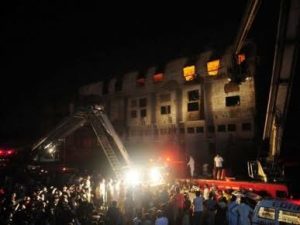
After this report, MQM sector in-charge Abdul Rehman alias Bhola was arrested from Bangkok and brought to Pakistan, while the second accused Muhammad Zubair alias Charia was also arrested. Then, on September 22, 2020, a major turning point came in this case when the Anti-Terrorism Court, after a long hearing and the statements of hundreds of witnesses, sentenced both the accused to death by the court.
The report revealed that this was not an accident, but rather a chemical was sprayed on the factory and set on fire by a political party, MQM, for not paying a bribe of Rs 200 million. Terrorism provisions were also included in the case. After this report, MQM sector in-charge Abdul Rehman alias Bhola was arrested from Bangkok and brought to Pakistan, while the second accused, Muhammad Zubair alias Charia, was also arrested. Then, on September 22, 2020, a major turning point came in the case when the Anti-Terrorism Court, after a long hearing and the statements of hundreds of witnesses, sentenced both the accused to death by the court. Four factory employees were sentenced to life imprisonment for the crime of aiding and abetting, while MQM leader Rauf Siddiqui was acquitted on the basis of lack of evidence. On September 2023, the accused approached the Sindh High Court against the sentences. After continuous hearings, the Sindh High Court upheld the trial court’s decision, so the death sentences of the accused Abdul Rehman alias Bhola and Zubair Charia remained. Hundreds of witnesses appeared in the trial court and the Sindh High Court who clearly stated that they saw Abdul Rehman alias Bhola and Zubair Charia throwing chemicals and closing the doors, preventing the burning people from getting out. Then, in the light of the JIT report, the trial court, the Anti-Terrorism Court and the Sindh High Court had given their verdicts, in which the death sentence of both the accused was upheld.
Finally, on June 10, 2026, what happened that the matter changed as soon as it went to the Supreme Court and both the accused were acquitted. Barrister Farogh Naseem, the accused and MQM’s lawyer, argued in the Supreme Court.
He told the BBC that ‘Our position was that when the fire broke out in 2012, an FIR was registered against the factory owners. The allegation was that they had barricaded all the windows and blocked all the entrances and exits, except one, due to which the people inside were trapped.’
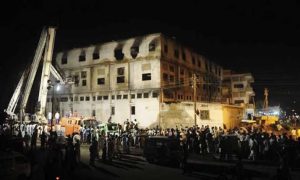
According to Farogh Naseem, ‘The owners did not complain for three years that the MQM people had done this or that they had demanded extortion. Suddenly, three years later, they remembered that an accused, Rizwan Qureshi, who had appeared before the JIT in another case and revealed that the factory had been set on fire by these people, after which the action began.’
In the arson case at this factory called Ali Enterprises, former MQM provincial minister Rauf Siddiqui, Karachi organization chief Hammad Siddiqui, then MQM sector in-charge Abdul Rehman alias Bhola, Zubair Charia, Hyderabad businessman Dr. Abdul Sattar Khan, Omar Hassan Qadri, Iqbal Adib Khanum, factory watchman Shahrukh, Fazal Ahmed, Arshad Mahmood and Ali Muhammad were named as accused. The court has ruled in its decision that the factory did not catch fire but was set on fire.
The accused had filed an appeal in the Sindh High Court against the decision of the Anti-Terrorism Court. The High Court has rejected the appeals against the death sentence of Abdul Rehman Bhola and Zubair Charia, but has accepted the appeals of the four accused who were sentenced to life imprisonment.
It has been a long time since those who died in the fire passed away, but justice has been murdered now and thus all the accused have been acquitted with honor. This is not the first incident in which justice has been murdered. The history of the Pakistani judiciary is full of cases in which justice has been murdered. Unfortunately, we have nothing to say or do except this.