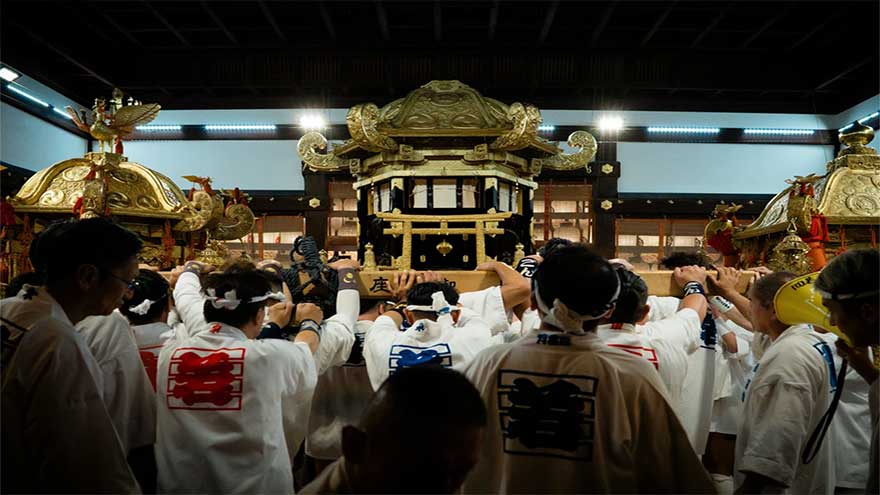
KYOTO, Japan (AP) — There’s a special moment when Katsushi Horikawa feels closer to the gods. It comes as he rides atop one of the towering floats pulled through the streets in a centuries-old procession in Japan._x000D_
_x000D_
This is the Gion Matsuri festival, born more than 1,000 years ago as a ritual to ward off epidemics and celebrated in the former imperial city of Kyoto throughout July._x000D_
_x000D_
“I am conscious of them when I’m riding on top,†Horikawa said. “When we’re assembling it as well, but I think the main time is when I’m riding on it.â€_x000D_
_x000D_
The parades — accompanied by dances, music and song — draw large crowds and tourists every year. The biggest floats can weigh up to 12 tons. Yet behind the festive atmosphere lies a tradition rooted in the worship of deities and rituals of protection._x000D_
_x000D_
“Those performances are not meant primarily for the entertainment of people,†said Fabio Rambelli, a religious studies professor at the University of California, Santa Barbara. “They are offerings to the gods.â€_x000D_
_x000D_
The Gion Matsuri originated in the late 9th century as a ritual to appease spirits believed to cause epidemics and to pray for protection from disease. It takes its name from Kyoto’s Gion District and “matsuri,†the Japanese word for festival._x000D_
_x000D_
At the heart of the celebration is Kyoto’s Yasaka Shrine, a Shinto site whose principal deity has long been revered as a protector against calamities. But the shrine’s history also reflects centuries of interaction between Shinto and Buddhism in Japan._x000D_
_x000D_
“Until about 150 years ago it was a Buddhist temple,†Rambelli said. “That’s part of the religious changes that have taken place in Japan.â€_x000D_
_x000D_
Back then, the sanctuary’s main deity was Gozu TennÅ, an ox-headed figure believed to have the power either to spread epidemics or to avert them._x000D_
_x000D_
“It was a kind of syncretic deity — probably of Indian origin — with connections to Korea and local folklore,†Rambelli said. “A lot of gods in Japan are a mixture of different traditions.â€_x000D_
_x000D_
Early versions of the Gion Matsuri involved that deity, Rambelli said._x000D_
_x000D_
To show evil forces and spirits that their god would confront them, devotees carried him around the city in processions that resembled those seen throughout Kyoto today._x000D_
_x000D_
A shrine’s turn from Buddhism helps shape today’s Shinto practices_x000D_
_x000D_
_x000D_
Japan’s government separated the two traditions of Shinto and Buddhism in 1868 during the Meiji era, effectively bringing Shinto shrines under state control and placing the emperor at the center of the new order._x000D_
_x000D_
“Because the emperor was the direct descendant of the goddess of the sun, they purified the whole system creating what now we see as Shinto,†said Andrea De Antoni, professor of anthropology and religious studies at the University of Kyoto._x000D_
_x000D_
De Antoni said a strong anti-Buddhist movement followed. Temples, mandalas and statues were burned and destroyed._x000D_
_x000D_
Shinto was formally separated from the state after World War II, but its traditions still reflect a broader history of religious and cultural influences._x000D_
_x000D_
“It is an institutionalized religion that revolves around ideas of deities called kami and different spirits,†De Antoni said._x000D_
_x000D_
“Kami shares its rules with general ideas of animism that can be found throughout the world, but there are a lot of similarities with certain parts of Southeast Asia and with the Pacific,†he added._x000D_
_x000D_
Japanese festivals often serve as ways for deities to be brought into the streets for sacred or ritual purposes while also bringing communities together in celebration._x000D_
_x000D_
“This is the festival of all the people in the neighborhood,†said Jacques Garrigues, a Frenchman who has lived in Kyoto for three decades and who attended the Gion Matsuri procession with his son on Friday._x000D_
_x000D_
“We also come together through a certain sense of religion, although the religious significance is not the same as in France,†he added._x000D_
_x000D_
Among the traditions preserved by the Gion Matsuri is the choosing of a boy as a sacred messenger to the gods. During the parade, the selected boy is seen sitting on one of the floats, his feet never touching the ground._x000D_
_x000D_
Some key participants spend months getting ready for the celebrations. Different neighborhoods prepare their floats with great care and dedication, with many people trusting the floats will drive away evil spirits._x000D_
_x000D_
Atsushi Matono is responsible for erecting the shingi, a sacred tree placed at the top of one of the floats —the holiest part of the structure, to which a deity is believed to descend._x000D_
_x000D_
Like Horikawa, he describes feeling a sacred presence._x000D_
_x000D_
“I always carry out my work with great care and respect,†Matono said. “Feeling the presence of the gods.â€