
Israel appears to be pulling every lever at once in an attempt to pressure Turkiye, challenging its interests on every front — from the Eastern Mediterranean to the Levant and from the Horn of Africa to the South Caucasus.
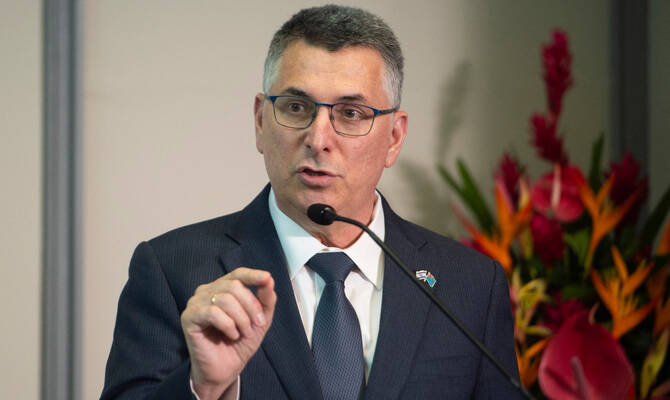
The Israeli government on Sunday decided to recognize the events of 1915 as genocide, in contrast to its decades-long policy. The Cabinet vote was proposed by Gideon Sa’ar, the foreign minister. It was previously Sa’ar who, in his first speech after taking office, suggested Israel reach out to the Kurds in an attempt to pressure Turkiye. According to him, Turkiye was once considered an ally of Israel but now Tel Aviv views the Kurds — whom Ankara perceives as a national security threat — as its “natural allies.”
However, Israel’s attempt to play the Kurdish card proved unsuccessful in both Syria and Iran. Israeli policy toward the Kurds was driven by tactical interests, not principles. As a result, rather than aligning with Israel’s regional agenda, the Kurds in Syria decided to reach a deal with the central government in Damascus, while Kurdish groups in Iran refrained from joining the US and Israel’s war against the Tehran regime.
Following the failure of its Kurdish strategy in the Middle East, Israel shifted its focus to the Horn of Africa by deciding to recognize Somaliland as a sovereign state — the first country to do so. It described the move as being in the spirit of the Abraham Accords, which normalized relations between Israel and a few Arab states. The decision, however, encountered strong regional opposition. Several regional powers, including Turkiye, Egypt and Saudi Arabia, warned that Israel’s move could further destabilize the Horn of Africa.
Following the failure of its Kurdish strategy in the Middle East, Israel shifted its focus to the Horn of Africa
Dr. Sinem Cengiz
Following the Israeli move, Somali President Hassan Sheikh Mohammed traveled to Turkiye — a clear signal to Israel that Somalia would not be drawn into Israel’s playbook. Similarly, after Israel recognized the events of 1915 as genocide, Armenian Prime Minister Nikol Pashinyan stated that he saw no need to respond to Israel’s move, arguing that avoiding the “weaponization” of the issue was in the interest of Yerevan.
Any policy aimed at undermining peace in the South Caucasus is also likely to fail. It would fail because Turkiye, Armenia and even Azerbaijan are now on the same page regarding the need for regional stability after decades of tense relations. Since 2021, Turkiye and Armenia have been engaged in a normalization process. Their relations are currently experiencing their most positive phase. Pashinyan visited Turkiye in 2023 and has met President Recep Tayyip Erdogan more than once.
It would not be surprising to see spoilers trying to complicate this process. However, Israel’s announcement is unlikely to derail the progress made so far. More importantly, Tel Aviv appears to be misreading the evolving regional dynamics. It is facing growing regional isolation and even its close ally Azerbaijan opposed Sunday’s decision, describing it as “a distortion of the historical facts.”
Baku had tried to facilitate a reconciliation process between Turkiye and Israel before the Gaza war erupted. And Azerbaijan last year reached an agreement with Armenia on the text of a peace treaty, helping push Armenian-Turkish relations forward.
Tel Aviv appears to be misreading the evolving regional dynamics. It is facing growing regional isolation
Dr. Sinem Cengiz
Moreover, as part of the normalization track with Ankara, Armenia’s Foreign Ministry said in 2024 that international recognition of the events of 1915 as genocide was no longer a priority in its foreign policy. So, Israel is pursuing a highly controversial policy that risks destabilizing an already-fragile region. Turkiye, Armenia and Azerbaijan can clearly see Israel’s intentions and they have therefore closed ranks to avoid the South Caucasus becoming part of Tel Aviv’s geopolitical chessboard.
America’s pro-Israel lobby groups have historically been supportive of Turkish interests during periods of tension in the Turkish-Armenian and Armenian-Azerbaijani relations. The lobbies were effective in influencing the White House and pressing lawmakers not to advance a bill that would recognize the events as genocide. However, Congress ultimately did so in 2019.
Israel’s changing attitude proves that its approach toward the 1915 events is not ideologically driven but is instead dependent on the course of its relations with Turkiye. Israeli officials — who constantly adopt a bipartisan rhetoric against Turkey — now appear to be using the issue as a direct tool against the trilateral process in the South Caucasus.
It is not only Armenians and Turks but also many people in Israel who know that the Tel Aviv government is trying to distort history in order to take revenge on Turkiye. This is not surprising, as Israel has repeatedly misread history and often found itself on the wrong side of it.
There is an ongoing rivalry between Turkiye and Israel that is closely tied to the broader regional order each seeks to shape. This rivalry has become a structural constraint, shaping dynamics from the Horn of Africa to the Levant and the South Caucasus. Turkiye’s responses to Israeli attempts to pressure it have generally been cautious and calibrated, relying on consolidated regional relations that not only limit Israel’s room for maneuver but also push Tel Aviv to press all buttons simultaneously in an effort to counterbalance Turkiye’s influence.
However, many of these Israeli efforts remain tactical in nature and have not produced the desired outcomes. Regional states are increasingly resistant to fragmentation and this emerging regional logic is becoming a defining feature of the current era — one that Israel has yet to fully understand.(Courtesy Arab News)