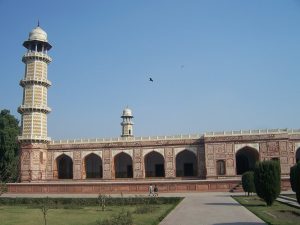
Jahangir’s Tomb – the identity of Lahore – holds a history within it. There are many historical buildings in Pakistan that bring back memories of the past. Many of these buildings are located in the heart of Lahore, Pakistan, such as the Badshahi Mosque, the Shahi Qila, and the Wazir Khan Mosque. Among them is the Jahangir Tomb, which is still there with its glory and splendor and holds a history within itself. The Jahangir Tomb was built during the Mughal era. It is located in a beautiful garden in Shahdara on the other bank of the Ravi River. Jahangir’s widow, Queen Shah Noor Jahan, started its construction, while Shah Jahan completed it. This tomb is considered the most beautiful tomb in Pakistan. Beautiful minarets are installed on all four corners of the tomb. Tourists from far and wide travel to Lahore to see this tomb. During the Sikh era, this tomb was severely damaged. The Sikhs uprooted the tomb and took it to Amritsar. Emperor Jahangir, like his father Akbar, had a great affection for Lahore._x000D_
_x000D_
 _x000D_
_x000D_
When he died in 1624 during a trip to Kashmir, he expressed his desire to be buried in Lahore before his death. Therefore, he was buried in the beautiful garden of Queen Noor Jahan. Shah Jahan spent one million rupees on the construction of the tomb. Huffaz were appointed to recite the Holy Quran, who would take turns reciting the Quran at the tomb at all times. Queen Noor Jahan also built a beautiful mosque within the boundaries of Jahangir’s tomb. Noor Jahan also resided here for a long time, so residential buildings were also built here. The tombs of Queen Noor Jahan and Emperor Jahangir were in the same area, but when the British laid a railway line between them, the tombs of Jahangir and Noor Jahan were separated from each other. There are beautiful minarets on all four corners of Jahangir’s tomb, each minaret is one hundred feet high and has sixty-one steps. The tomb building is on a square platform. The tomb’s talisman is made of marble and is decorated with agate, sapphire, coral and other precious stones. The ninety-nine names of Allah are engraved on the right and left. Bismillah al-Rahman al-Rahim is written on the headboard. Marble lattices are installed on all four sides of the tomb. The interior floor of the tomb is decorated with various precious stones such as marble, stone Moses and stone Abri._x000D_
_x000D_
 _x000D_
_x000D_
The western gate of Jahangir’s tomb, through which an elephant with a rider could pass, and the wells outside the four walls have been filled with water, only one well remains. There are still ancient palm trees inside the garden. There is a long row of rooms along the walls of the garden where the royal guards, soldiers and servants used to live. The tomb of Jahangir was badly damaged during the attacks of Nadir Shah and Ahmad Shah and the Sikh era. Despite this, this building still stands with great splendor and reminds us of its past. Jahangir’s tomb has been a symbol of Lahore for centuries. Being a historical building, Jahangir’s tomb is always crowded with tourists. A large number of women and children visit here to see Jahangir’s tomb.