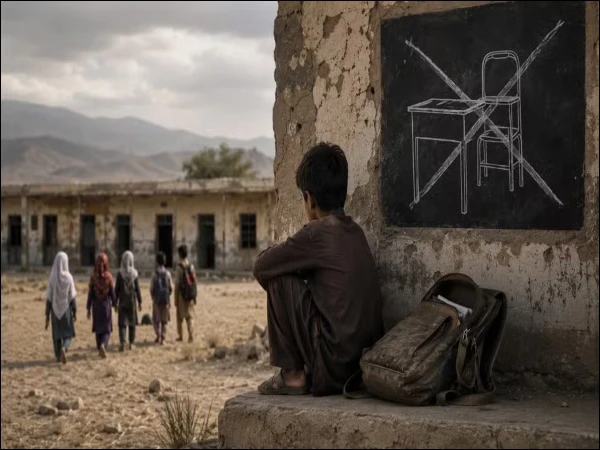
More than two years after the declaration of an education emergency in Pakistan, the country’s education crisis has persisted rather than abated. A new policy report has revealed that between 25.1 million and 26 million children are still out of school in the country, raising serious questions about the performance of the education system._x000D_
_x000D_
The report, based on a comparative policy review prepared by the Civil Services Academy (CSA), warns that although provinces have prepared ambitious goals and roadmaps under the National Education Action Plan (NEAP) 2026, the real problem is to implement these plans_x000D_
Decades-old problems and weak system roots_x000D_
_x000D_
According to the report, the education crisis in Pakistan did not emerge suddenly but is the result of decades-old problems, including a rapidly growing population, poverty, weak governance and persistent underinvestment in the education sector. The document states that the government education system has not been able to expand its capacity in line with the growing demand, leading to the expansion of low-cost private schools._x000D_
_x000D_
Article 25-A of the Constitution of Pakistan guarantees free and compulsory education to every child, but the reality on the ground is the opposite._x000D_
Punjab province bears the heaviest educational burden_x000D_
_x000D_
The report states that the highest educational challenge in the country is faced by Punjab province, where about 9.6 million to 14 million children are out of school. According to the 2026 baseline data of the Punjab School Education Department, 6.4 million children have never been to school, while 3.16 million children have left school incompletely, which makes it clear that not only admission but also retaining children in school is a major problem._x000D_
_x000D_
Specific problems of other provinces_x000D_
_x000D_
According to the report, dropout of children after primary school increases in Sindh, while recurring climatic disasters also affect the education system. Security challenges, difficult geography and a shortage of female teachers are the main problems in Khyber Pakhtunkhwa. On the other hand, weak institutional framework, dysfunctional schools and scattered population in Balochistan are major obstacles to educational progress._x000D_
_x000D_
Although the situation is relatively better in Islamabad, Gilgit-Baltistan and Azad Jammu and Kashmir, the report says that even in these areas, there are internal inequalities._x000D_
_x000D_
A uniform policy is insufficient for the solution_x000D_
_x000D_
The CSA report concludes that although the national education emergency has highlighted the problem at the political level, Pakistan’s education crisis cannot be solved with a “one-size-fits-all†policy. For this, strong implementation, good governance and sustained investment according to the specific situation of each province are essential._x000D_
_x000D_
The report emphasizes that unless education is given real priority and policies are effectively implemented on the ground, millions of children will remain out of school.