
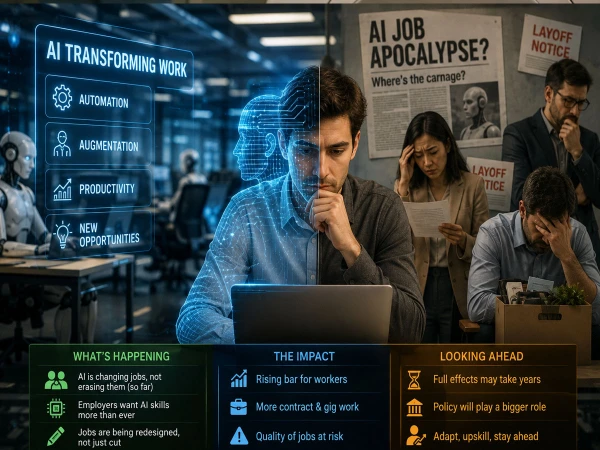
With the rapid spread of artificial intelligence, predictions were gaining momentum that AI would eliminate a large number of white-collar jobs and create a job crisis for the white-collar class, but the data available until 2026 did not fully confirm this fear.
Some heads of American technology companies warned last year that AI could eliminate a large number of jobs in the coming years, and some predictions even expressed the fear of the elimination of a large part of entry-level white-collar jobs.
However, a recent study by the Stanford Institute for Economic Policy Research has given encouraging news that at present the impact of AI on overall employment is relatively limited, but what is going to happen in the future is worrying.
The study found that unemployment in the 20% of sectors most affected by AI increased by about 0.77 percentage points after the introduction of ChatGPT in 2022, compared to 0.85 percentage points in sectors least affected by AI.
This clearly shows that the overall data does not yet paint a clear picture of the large-scale elimination of jobs due to AI.
The real change is currently seen in the way jobs are being replaced, with many organizations automating tasks that were previously performed by employees, merging the responsibilities of some positions, and trying to take more work from existing staff rather than new hires.
While AI’s impact on overall employment is currently limited, the study found that the situation is more worrisome for new graduates and early-career workers.
At the beginning of 2026, the unemployment rate for recent graduates in the United States reached 5.6%, which was higher than the national average.
Experts say AI may have a role to play, as many entry-level jobs involve research, data analysis, writing and routine clerical tasks that AI can now perform with relative ease.
However, it would be inaccurate to attribute the rise in unemployment rates solely to AI; interest rates, excessive hiring during the pandemic and changes to remote work could also play a role.
Another Stanford study also found a relatively significant decline in the employment of 22- to 25-year-old workers in sectors most affected by AI, raising concerns that AI’s initial impact may be greater on younger and less experienced workers.
Are ‘AI skills’ more important than degrees now?
The criteria for getting a job are also changing in the AI era. Companies are increasingly looking for people who can use artificial intelligence tools to integrate them into their work and deliver better results in less time.
This change does not mean that every employee has to be a programmer, but rather that the ability to work with AI in various fields is becoming an additional skill. That is, in the future, the question will not only be what the candidate knows, but also how much he can improve the speed and quality of his work by using AI.
AI will take some jobs, it will also create new jobs
Economists say that major technological changes usually do not just eliminate jobs, but also change the nature of work and create new jobs.
AI is increasing the need for specialists who can develop, implement, sell, monitor and repair artificial intelligence systems. This may also increase the importance of employees who can perform better in areas such as evaluating AI results, decision-making, creative work and human interaction.
Stanford research also indicates that the major economic impacts of technology are often not immediately apparent; Like the computer revolution, AI may take years to fully integrate into company systems, employee training, and work practices.
Freelance work instead of ‘permanent employment’?
On the other hand, experts fear that AI could also affect the quality of jobs in the long term. It may be easier for some companies to hire freelancers, contractors, and temporary workers as needed instead of hiring permanent employees.
In this case, the job will still be there, but the employee will not have the opportunity for growth, stable income, and long-term career that is available in traditional employment.
The research also shows that the overall impact on employment in companies that have adopted AI has been limited so far, while companies’ future projections point to a much larger impact.
In an international business study, most companies reported no significant impact on employment or productivity due to AI in the past three years, but the number of companies expecting job losses in the coming years is increasing.
The real competition is not about jobs, but about skills?
Given the current situation, experts say the biggest challenge in the AI era may not be how many jobs will disappear, but how many jobs will require new skills.
That is, AI is not yet replacing humans on a large scale, but it can certainly leave behind employees who are not ready to change themselves with new technology.
Therefore, experts suggest that workers should not just wait for AI to take their jobs, but learn to use AI with their existing skills.
It will be important for high-skilled workers to update themselves with new technologies, while government policies may be needed to protect low-wage and low-skilled workers.